We often see RF designs that look correct from a schematic perspective but fail to achieve the expected performance after fabrication. In many cases, the issue isn’t the circuit itself; it’s the PCB layout.
At RF frequencies, small layout decisions can significantly affect impedance, loss, radiation, and signal integrity. What works for a digital PCB may not work for an RF design operating at several gigahertz.
I wanted to start a discussion on the RF layout practices that have worked well for your designs.
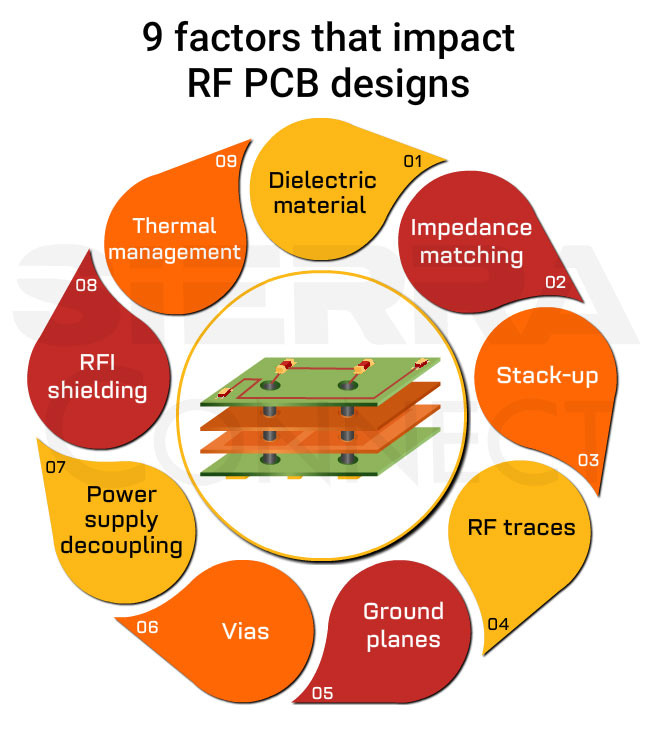
RF performance is heavily influenced by controlled impedance routing, material selection (Dk and Df), stack-up, return-path continuity, via and connector transitions, grounding strategy, component placement, shielding, and thermal management.
Even with correct schematic and basic impedance control, poor layout decisions can significantly degrade RF performance, especially as frequencies move into GHz and mmWave ranges.
1 Like
From a layout standpoint, a few practices consistently improve RF performance:
- Maintain consistent controlled impedance throughout the entire RF path
- Keep RF traces as short and direct as possible
- Use continuous reference planes under RF routes
- Avoid routing across plane splits or gaps. Provide continuous, unbroken ground planes directly under RF traces
- Minimize layer transitions and unnecessary vias
- Place stitching vias around RF ground regions and transitions
- Keep sensitive RF sections isolated from noisy digital and power circuits
- Design connector launches carefully to minimize impedance discontinuities
A practical rule is to think about where the return current flows. Many RF problems originate from interrupted return paths rather than the signal trace itself.
Material and stack-up decisions are equally important.
For higher-frequency designs, consider:
- Low-loss laminates when standard FR-4 becomes too lossy
- Stable dielectric properties across the operating frequency range
- Consistent dielectric thickness for impedance control
- Proper grounding structures for coplanar waveguides or microstrip routing
It also helps to involve your fabrication partner early when defining stack-up and impedance requirements. Small changes in dielectric thickness, copper geometry, or material properties can significantly affect RF performance.
Additional critical considerations include:
- Careful placement of RF components to minimize trace lengths
- Strategic connector launches with proper impedance matching
- Paying attention to solder mask removal over RF traces at higher frequencies
- Ensuring good thermal management so heat doesn’t affect dielectric properties
Of course, the best RF layout approach always depends on your operating frequency, power level, and application, so align with your fabrication partner as early as possible. For a comprehensive set of best practices and practical layout tips for RF PCBs, I recommend watching this webinar: Best RF Design and Layout Practices.