We often see designers facing problems when handing off files to fabrication, either missing one critical file, incomplete documentation, sending outdated versions, or spending hours trying to compile Gerbers + ODB++ + stack-up drawings + impedance specs + BOM + assembly notes. So I wanted to start a discussion on how teams handle design data transfer reliably.
In a typical workflow, designers generate multiple outputs such as Gerbers, drill files, netlists, stack-up details, assembly drawings, BOM, and centroid data.
Managing all these files increases the chances of:
These issues directly impact NPI timelines, often delaying builds even before fabrication begins.
The core challenge is that traditional formats like Gerber are image-based and fragmented, so the manufacturing intent isn’t always fully captured.
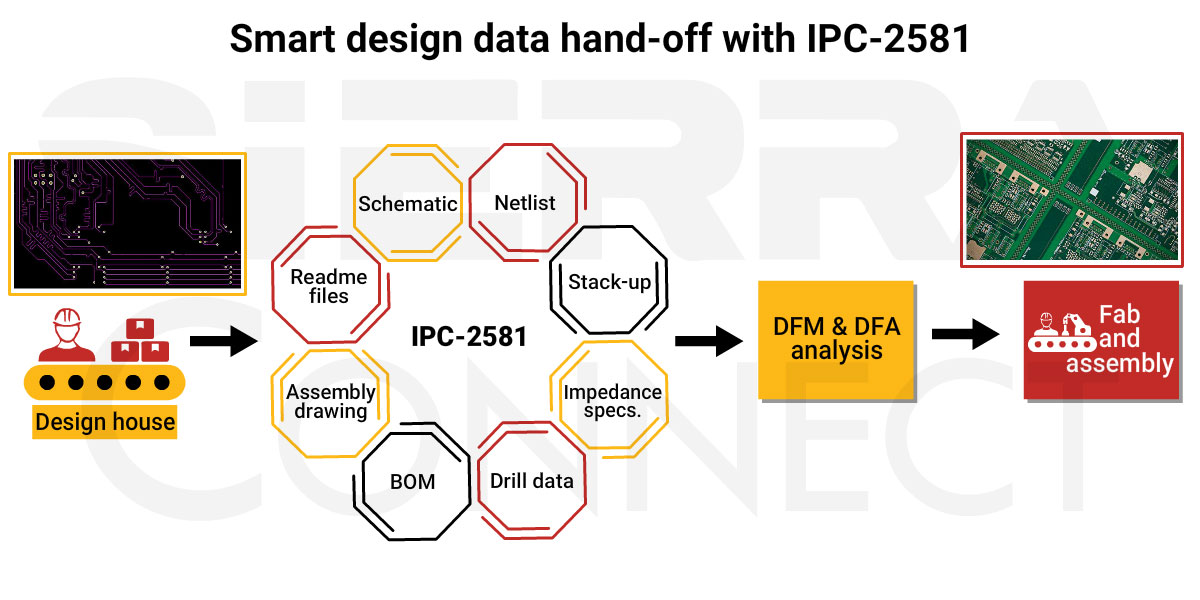
One approach that addresses this problem is moving toward unified data formats like IPC-2581.
Instead of sending multiple files, IPC-2581 (IPC-DPMX) packages include:
-
Fabrication data (layers, drills, stack-up)
-
Assembly data (BOM, component placement)
-
Design intent (netlist, impedance, constraints)
Consolidating everything into a single intelligent file reduces file management errors, manual interpretation by CAM engineers, and the risk of inconsistencies between fabrication and assembly data.
It also enables direct integration into CAM systems, reducing the need for manual data preparation and speeding up NPI cycles.
Another advantage is bi-directional communication.
With IPC-2581:
-
Fabricators can send DFM feedback directly tied to the design
-
Designers can resolve issues within the same data structure
-
Changes and approvals can be tracked more clearly with a machine-readable format that speeds up CAM processing and aligns with Industry 4.0.
This reduces reliance on spreadsheets, emails, and disconnected feedback loops, which are common sources of errors and delays.
Not all fabs fully support IPC-2581 yet, and many teams still rely on Gerber or ODB++. But for complex designs or fast NPI cycles, having a complete and consistent data handoff becomes critical.
Of course, the best approach always depends on your design complexity and fab capabilities, so discuss IPC-2581 support with your manufacturer early in the project.
For a complete walkthrough of how IPC-2581 works, its benefits over traditional formats, and real-world NPI examples, I recommend watching this Sierra webinar: IPC-2581: Expedite NPI with Smart Design Data Hand-off.